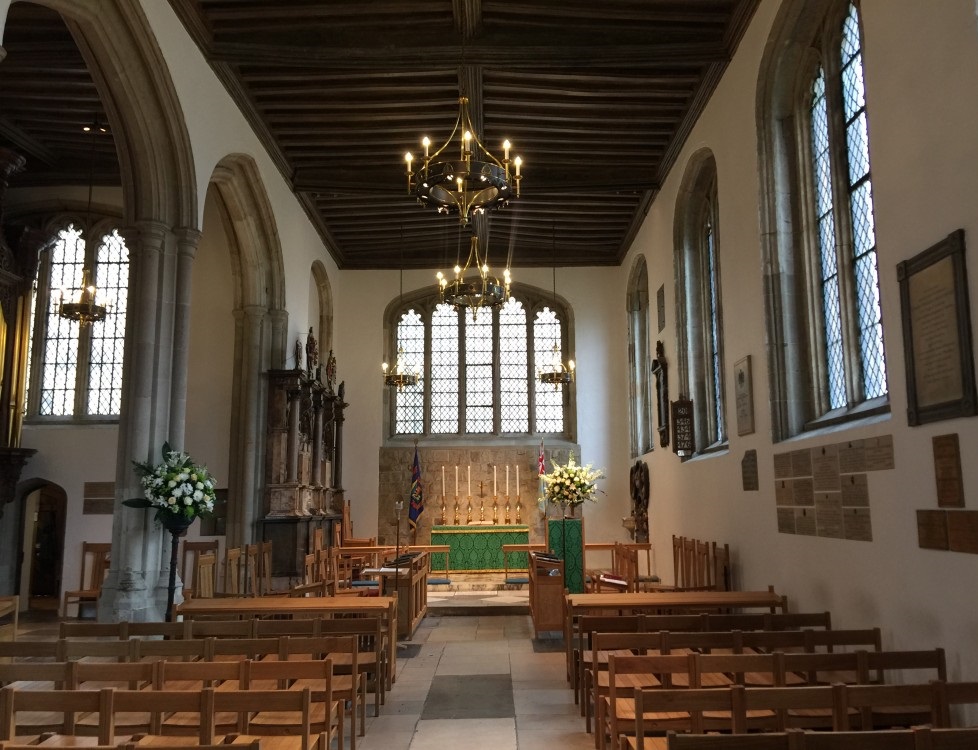
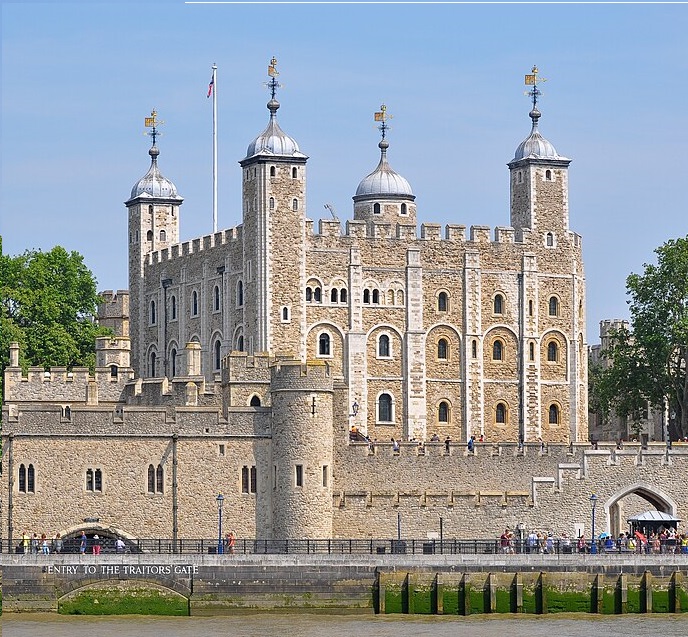
Located north of Tower Green, the Royal Chapel of St Peter ad Vincula (Saint Peter in Chains) is one of the few remaining examples of a Tudor religious building. Three queens (Anne Boleyn, Catherine Howard, and Jane Grey) and two saints (Thomas More and John Fisher) are buried there. A third, Philip Howard, was also interred there until his remains were moved to Arundel in southeast England.
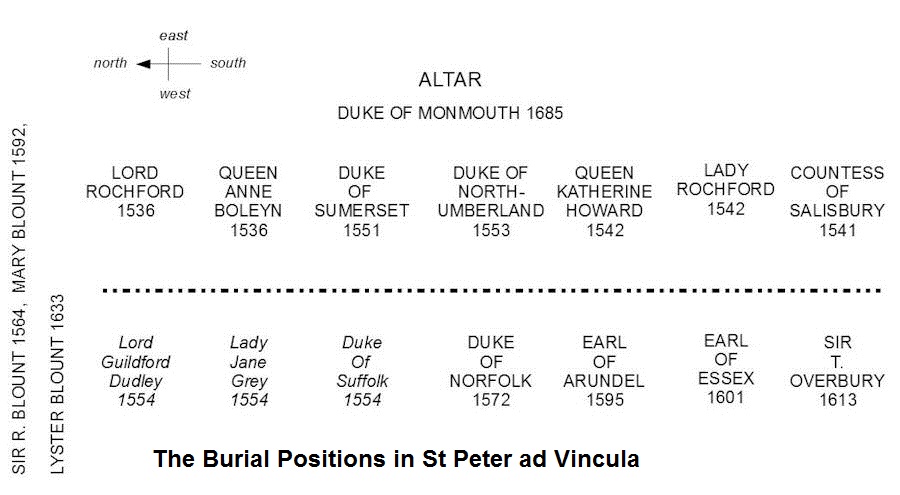
The plan above is based on the "suggested plan of burials in the chancel" from Doyne C. Bell's 1877 book, "Notices of the Historic Persons Buried in the Chapel of St Peter ad Vincula in the Tower of London," which details the restoration work carried out in the chapel in 1876 and 1877. Victorian-era workmen were responsible for laying the chancel floor tiles and marking the burial locations with the commemorative tiles that can still be seen today.
First Rank
LORD ROCHFORD
George Boleyn, known as Lord Rochford, born around 1503 and executed on May 17, 1536, was the brother of Mary Boleyn and Anne Boleyn, and the husband of Jane Parker. The son of diplomat Thomas Boleyn, 1st Earl of Wiltshire, and Elizabeth Howard, he was the brother-in-law of King Henry VIII and the uncle of the future Queen Elizabeth I. His maternal grandfather was Thomas Howard, 2nd Duke of Norfolk.
Convicted of incest with his sister Anne during his trial for treason, he was executed in the Tower of London.
QUEEN ANNE BOLEYN
See Anne Boleyn's Tomb
DUKE OF SUMERSET
Edward (sometimes Édouard) Seymour (born c. 1506 – 22 January 1552), 1st Earl of Hertford (1537–1552) and later 1st Duke of Somerset (1547–1552), was Lord Protector of England during the minority of his nephew Edward VI, from the death of Henry VIII in 1547 until his indictment in 1549.
Edward was the eldest brother of Jane Seymour, the third queen consort of Henry VIII.
DUKE OF NORTH-UMBERLAND
John Dudley (1504, London – Tower of London, 22 August 1553), 1st Earl of Warwick and later 1st Duke of Northumberland, son of Edmund Dudley and Elizabeth Grey, 6th Baroness Lisle.
Under Edward VI, he became the true power behind the throne, and was created Earl of Warwick, Duke of Northumberland, and High Marshal of England, supplanting Edward Seymour, Duke of Somerset, the Lord Protector. Somerset, having attempted to assassinate him in revenge, was put to death on January 22, 1552.
Led by ambition, Dudley conceived a plan to bring the crown into his family: seeing Edward VI near his grave, he persuaded him to exclude his own half-sisters, Mary Tudor and Elizabeth, from the throne on the grounds of illegitimacy, and then to choose as his heir Jane Grey, a descendant of Henry VII of England and a Protestant, to whom he had married one of his sons, Guilford Dudley.
Upon Edward's death in 1553, Jane did indeed receive the title of queen for nine days, but Mary Tudor, having had her rights recognized, ascended the throne, and Dudley, abandoned by all, was put to death, as were Guilford and Jane Grey later on. He was beheaded with an axe at the Tower of London.
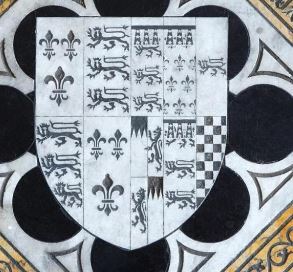
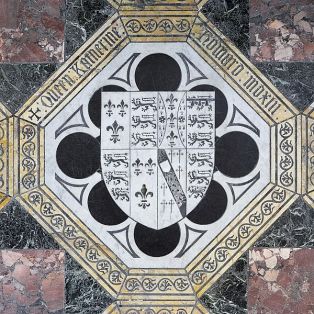
QUEEN KATHERINE HOWARD
See Catherine Howard's Tomb
LADY ROCHFORD
Jane Boleyn, better known as Lady Rochford, was the wife (and later widow) of George Boleyn. She served five of Henry VIII's six wives, contributing, according to legend, to the downfall of two of them: her sister-in-law Anne Boleyn and his mistress Catherine Howard, thus sealing her own fate. She was executed with Catherine Howard at the Tower of London in February 1542, condemned for complicity in Catherine's infidelities.
COUNTESS OF SALISBURY
Margaret Plantagenet, Countess of Salisbury (14 August 1473 – 27 May 1541), was the only surviving daughter of George Plantagenet, Duke of Clarence (brother of Kings Edward IV and Richard III), and his wife Isabella Neville. Following her marriage to Richard Pole, she was also known as Margaret Pole.
Margaret and Henry VIII were cousins. Both were descended from the sons of Edward III: Lionel of Antwerp, Duke of Clarence, for Margaret; and John of Gaunt, Duke of Lancaster, and Edmund of Langley, Duke of York (along with Lionel of Antwerp), for Henry VIII. Furthermore, Margaret's father, George Plantagenet, was the brother of Henry VIII's maternal grandfather, Edward IV.
A widow, appointed Countess of Salisbury and governess to Princess Mary, daughter of Henry VIII and Queen Catherine of Aragon, she opposed the king's marriage to Anne Boleyn and was banished from court by Henry VIII.
When her son, Cardinal Reginald, refused the Act of Supremacy, Margaret was imprisoned in the Tower of London for two years and beheaded on May 28, 1541. In 1538, two of her other sons had been executed. She was never given a legal trial; she was nearly 70 years old when she was martyred. She was beatified in 1886 by Pope Leo XIII.
2nd Rank
Lord Guildford Dudley
Lord Guildford Dudley was the son of John Dudley, Duke of North Umberland (1535-February 12, 1554), who was the husband of Lady Jane Grey, Queen of England for nine days.
Lady Jane Grey
Lady Jane Grey, born in October 1537 and died on February 12, 1554, in London, was briefly Queen of England in July 1553, between the death of her cousin Edward VI and his deposition in favor of Mary I. Her short reign earned her the nickname "Nine Days Queen."
Great-granddaughter of Henry VII, King of England, and granddaughter of Mary Tudor, widow of Louis XII, Jane Grey was chosen as successor by Edward VI, who excluded her half-sisters Mary and Elizabeth I from the line of succession to prevent Mary the Catholic from ascending the throne. However, the young queen was quickly ousted by her cousin Mary, who had her imprisoned in the Tower of London.
Fully aware that Jane had been manipulated by John Dudley, Mary initially wished to spare her. Nevertheless, she had her executed because of her alleged involvement in a conspiracy and because of the rebellion led by her father, the Duke of Suffolk.
Duke of Suffolk
Henry Grey (17 January 1517 – 23 February 1554), 3rd Marquess of Dorset and later 1st Duke of Suffolk, was an English nobleman of the Tudor period. He is best known as the father of the "Nine Days' Queen," Jane Grey.
Thanks to the friendship between his wife Frances and his cousin Mary, Grey, his daughter, and his son-in-law temporarily escaped execution. However, Mary had them executed after Henry Grey was convicted of high treason for his involvement in Thomas Wyatt's attempt to overthrow her when she announced her intention to marry Philip II of Spain.
DUKE OF NORFOLK
Thomas Howard, 4th Duke of Norfolk, born March 10, 1536, and died June 2, 1572, was an officer of the English Crown during the reign of Elizabeth I. Thomas Howard was a second cousin of Queen Elizabeth I through his maternal grandmother, Elizabeth Howard.
Queen Elizabeth imprisoned Norfolk in 1569 on suspicion of wanting to marry Mary of Scotland. Upon his release, he participated in Ridolfi's Plot, sponsored by Philip II of Spain, to place Mary of Scotland on the English throne and re-establish Catholicism in the kingdom. He was beheaded for high treason in 1572, and his remains were interred in the Chapel Royal, St. Peter in Chains, within the Tower of London.
EARL OF ARUNDEL
Philip Howard (June 28, 1557 – October 19, 1595), 13th Earl of Arundel, was a prominent English nobleman imprisoned on the orders of Queen Elizabeth I as a suspected conspiracy leader. He spent ten years in the Tower of London until his death from dysentery. He was canonized by Pope Paul VI in 1970 as one of the Martyrs of England and Wales. His feast day is October 19.
EARL OF ARUNDEL
Philip Howard (June 28, 1557 – October 19, 1595), was a prominent English nobleman imprisoned on the orders of Queen Elizabeth I as a suspected conspiracy leader.
EARL OF ESSEX
Robert Devereux, 10 November 1565 – 25 February 1601, 2nd Earl of Essex, was a favorite of Elizabeth I of England, disgraced in 1600 and, after plotting a conspiracy, beheaded with an axe in 1601.
He was the son of Walter Devereux (1541–1576), 1st Earl of Essex, and Lettice Knollys, granddaughter of Mary Boleyn, sister of Anne Boleyn.
SIR T.OVERBURY
Thomas Overbury was the son of Nicholas Overbury of Bourton-on-the-Hill (Gloucester), a Member of Parliament in the House of Commons, and Mary Palmer.
He was for a long time a friend and confidant of Robert Carr, Earl of Somerset, a favorite of James I; but, having thwarted the favorite's plans for the Countess of Essex, Carr had him imprisoned in the Tower on a false charge and poisoned there (1613). This death led to Carr's disgrace and a famous trial.