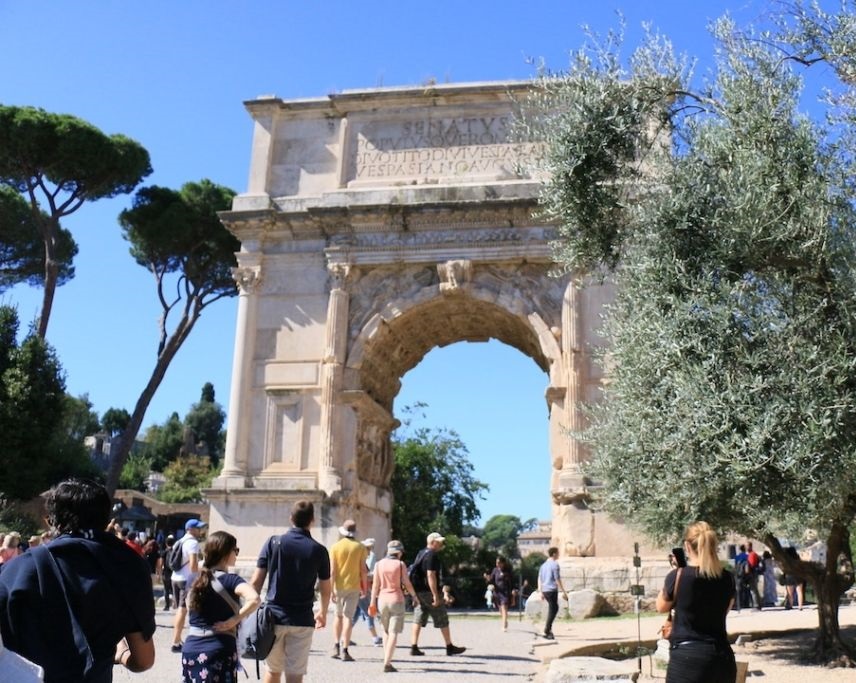
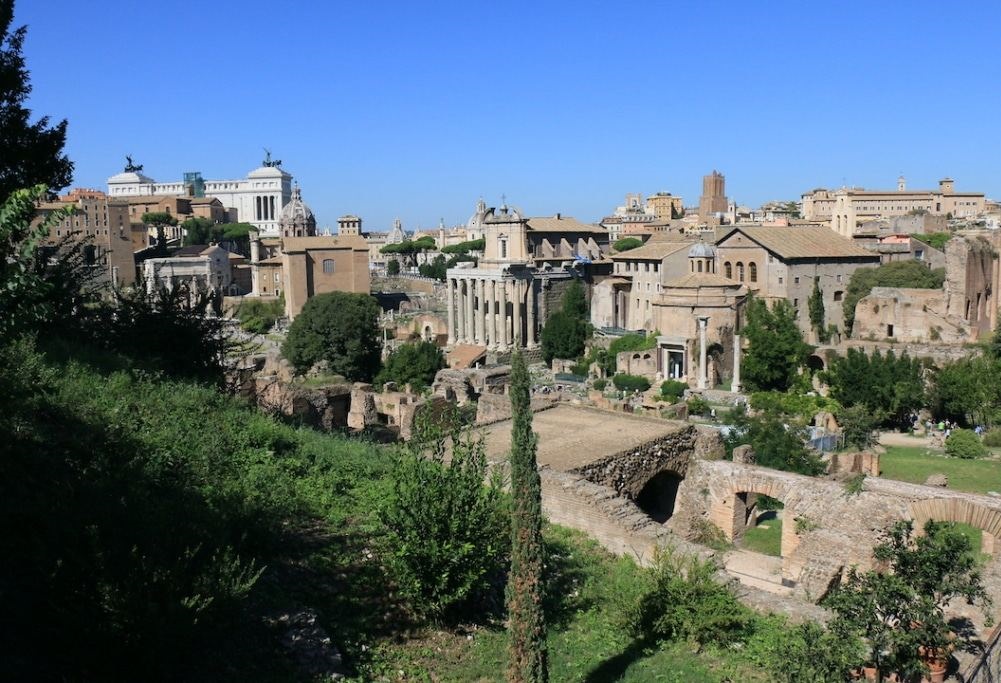
The arch stands along the Clivus Palatinus near its intersection with the Via Sacra, at the summit of the Velia (*in summa Sacra Via*) in modern-day Rome.
This arch was built in honor of Emperor
Titus
in 81 AD, commissioned by Emperor Domitian. It was erected largely to honor his numerous victories—such as those during the Jewish War of 66–73—and, above all, his capture of
Jerusalem.
The arch stands 15 meters tall and has undergone several renovations.
As a result, it remains in good condition today, allowing you to still see details carved into the stone.
It is the first thing you see when visiting the Forum, as it is located at the eastern entrance.
At an unknown date, the Chief Rabbinate of Rome imposed a local ban prohibiting Jews from walking under the arch. The arch commemorated the destruction of the Second Temple in Jerusalem and, by extension, the end of the existence of a Jewish "state." This prohibition was lifted by a Chief Rabbi at the time of the founding of the State of Israel in 1948, and again publicly during the Hanukkah festival in 1997.
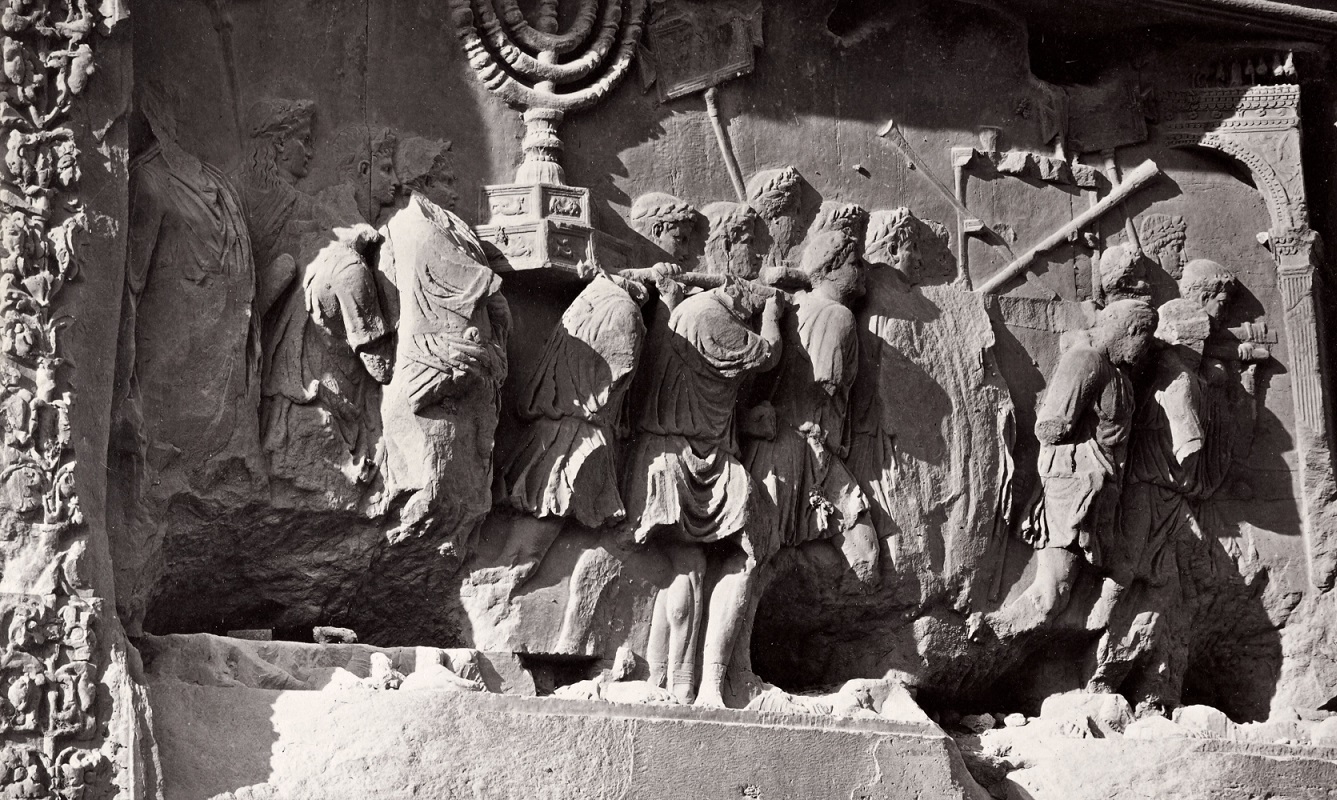
The inner wall of the Arch of Titus depicts Jewish prisoners, surrounded by Roman soldiers, carrying the Menorah (the Hebrew seven-branched candelabrum), the Table of Showbread, the Tablets of the Law, and the Ark of the Covenant that held them.
While the capture of Jerusalem—culminating in 70 CE with the burning of the Temple—was a traumatic experience for the Jewish population, it was celebrated as a great victory by the Roman authorities. In 71 CE, Titus celebrated a triumph in Rome, and ten years later, a triumphal arch was erected in his honor by Domitian. It depicts the spoils of the Temple, notably a large seven-branched candelabrum being carried in the triumphal procession.
The consequences of this defeat were immense for the Jews:
After the destruction of
Herod's
Temple, the Jews lamented having only a section of wall left for prayer (the Western Wall).
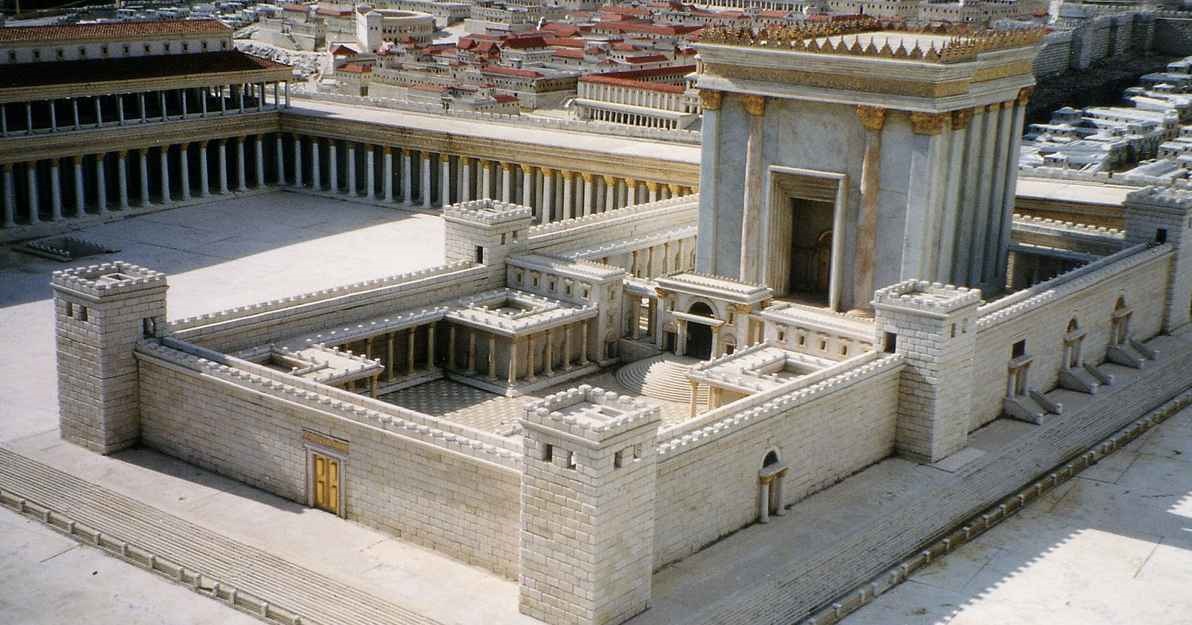
The Temple in Jerusalem had been expanded by Herod the Great; construction began in 19 BCE. The monumental construction project lasted nearly 46 years, continuing well after Herod's death (and was completed shortly before the Temple's destruction by the Romans in the year 70).
These events were recounted in detail by the Jewish historian—who later became a Roman citizen—Flavius Josephus; he had participated in the revolt before being taken prisoner in July 67 and entering the service of Vespasian in 69.
The Temple and Herod feature in the Gospels.
From the time of
Jesus's
birth, Herod—then in the twilight of his life—became extremely suspicious, obsessed with the fear of betrayal and the loss of his power.
Palace intrigues and dynastic plots fueled an ever-growing paranoia.
While some threats were indeed real, others were the product of his madness and fertile imagination. Warned by the Magi of the arrival of a King of the Jews, he sent his soldiers to kill all the newborn babies in Bethlehem. Jesus and his family escaped this fate by fleeing to Egypt after being warned by an angel.
Jesus is presented at the Temple shortly after his birth (the Purification). At the age of 12, he is found there sitting among the teachers of the Law, astonishing them with his intelligence.
Around the year 30, Jesus drove out the money changers and merchants who had set up in the courtyards, denouncing the transformation of "my Father's house" into a "den of thieves."
Jesus foretold the future destruction of the Temple, declaring that "not one stone will be left upon another"—a prophecy that came to pass during the Roman army's siege of Jerusalem in the year 70.
These episodes are recounted in the four canonical Gospels (Matthew, Mark, Luke, and John).
Berenice and Titus
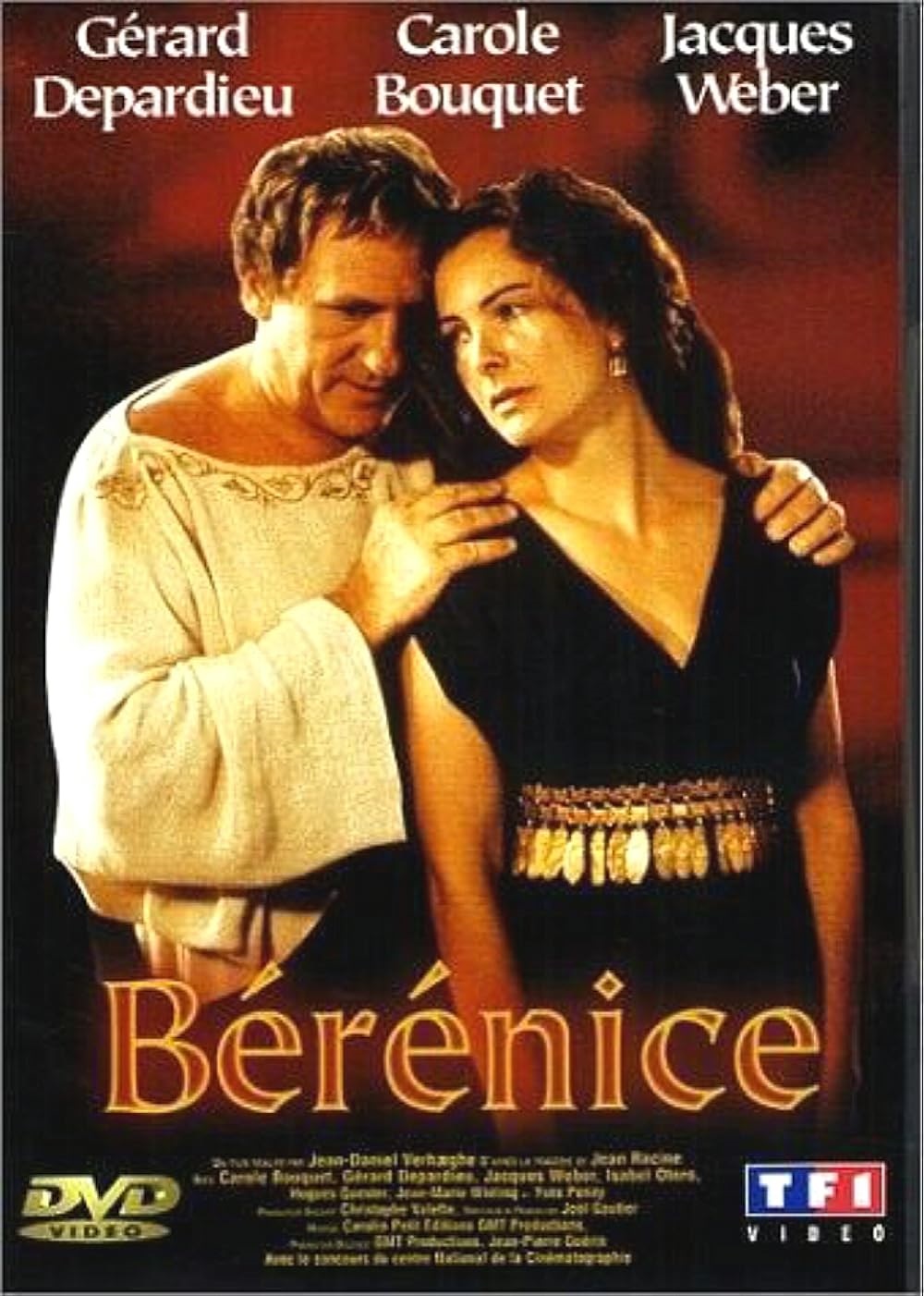
It was
Nero who had sent General Vespasian to quell the Jewish rebellion. However, having become emperor, Vespasian had to return to Rome in December 69. His son Titus continued the siege of Jerusalem; in 70, he conquered the city—and the heart of its queen,
Berenice.
Once Jerusalem was destroyed, Titus hastened to join Berenice in her capital. He then undertook a triumphal tour of the Roman East; Berenice and her brother Agrippa accompanied him on the journey.
Titus returned to Rome to celebrate his triumph (late 70 or early 71).
In 75 AD, Berenice came to Rome to join her lover—though still accompanied by her brother. She lived with Titus openly, for all to see; this sparked a scandal that would last for four years.
Why a scandal? Not because of moral concerns, but because a Roman could not unite with a "barbarian."
Ultimately, in June 79 AD, she was sent away from
Rome. Upon ascending the imperial throne and succeeding his father Vespasian, Titus dismissed Berenice—an act that pained both him and her.
Nothing more was heard of Queen Berenice. Some claimed she died in the year of the eruption of Mount Vesuvius.
Titus and Berenice at the Palace of Versailles
The impossible love story between the Roman Emperor Titus and Queen Berenice of Judea is one of the most famous and influential themes in the history of theater and the arts. Racine, Corneille, and many others have recounted this tale of a romance sacrificed on the altar of power.
The love story between the Roman Emperor Titus and the Jewish Queen Berenice became universally popular in November 1670.
In November 1670, Paris became the stage for an unprecedented literary showdown:
On November 21, 1670, Jean Racine premiered his tragedy *Bérénice* at the Hôtel de Bourgogne.
Barely a week later, on November 28, 1670, his great rival Pierre Corneille presented his own version, *Tite et Bérénice*, at the Palais-Royal.
This clash of giants captivated both the Parisian public and the Court. It was Racine’s version—brought to life by the star actress Mademoiselle Champmeslé—that achieved immense triumph and firmly cemented this myth in literary history.
The public was immediately captivated by the story because it resonated powerfully with the events of the day.
A few years earlier, the young King Louis XIV had been forced to give up his great love, Marie Mancini (Cardinal Mazarin’s niece), for purely political reasons in order to marry the Infanta of Spain. Titus’s dilemma—sacrificing personal feelings for the sake of his office and *raison d’État*—offered a striking mirror image of, and a direct tribute to, the Sun King’s own sacrifice.
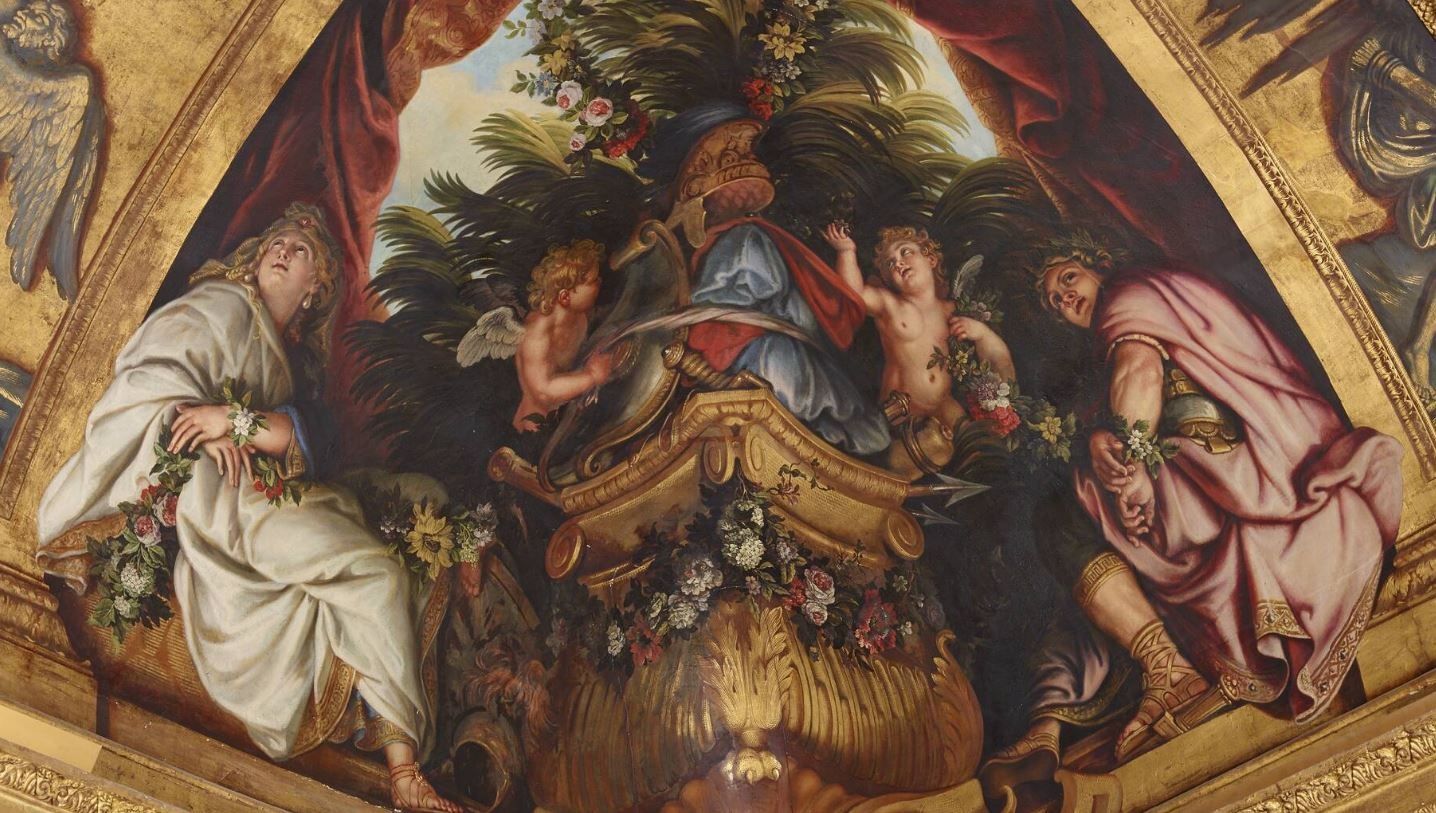
Louis XIV wished to immortalize this story of love renounced for the sake of power—an experience that had left a painful mark on him when he was forced to part ways with his beloved Marie Mancini.
He commissioned a painting for the
Palace of Versailles; it is located on the first floor of the central building, in the spandrel at the southwest corner of the coved ceiling in the Salon of Venus.
Titled *Titus and Bérénice Bound by Cupids with Flowers and Garlands*, the work symbolizes the thwarted union of these two historical figures through a decorative scheme rendered in shades of gold.